
How Escrow Works When Buying an Online Business
Etienne Hurpin, Founder of TrustExits · · 12 min read
You agreed on $380k for a Shopify brand. The seller wants wire on signing. You want keys after funds clear. Nobody moves until someone trusts a process — and in ecommerce, "trust" without verification gates is how buyers inherit banned ad accounts and sellers chase chargebacks on orders they no longer control.
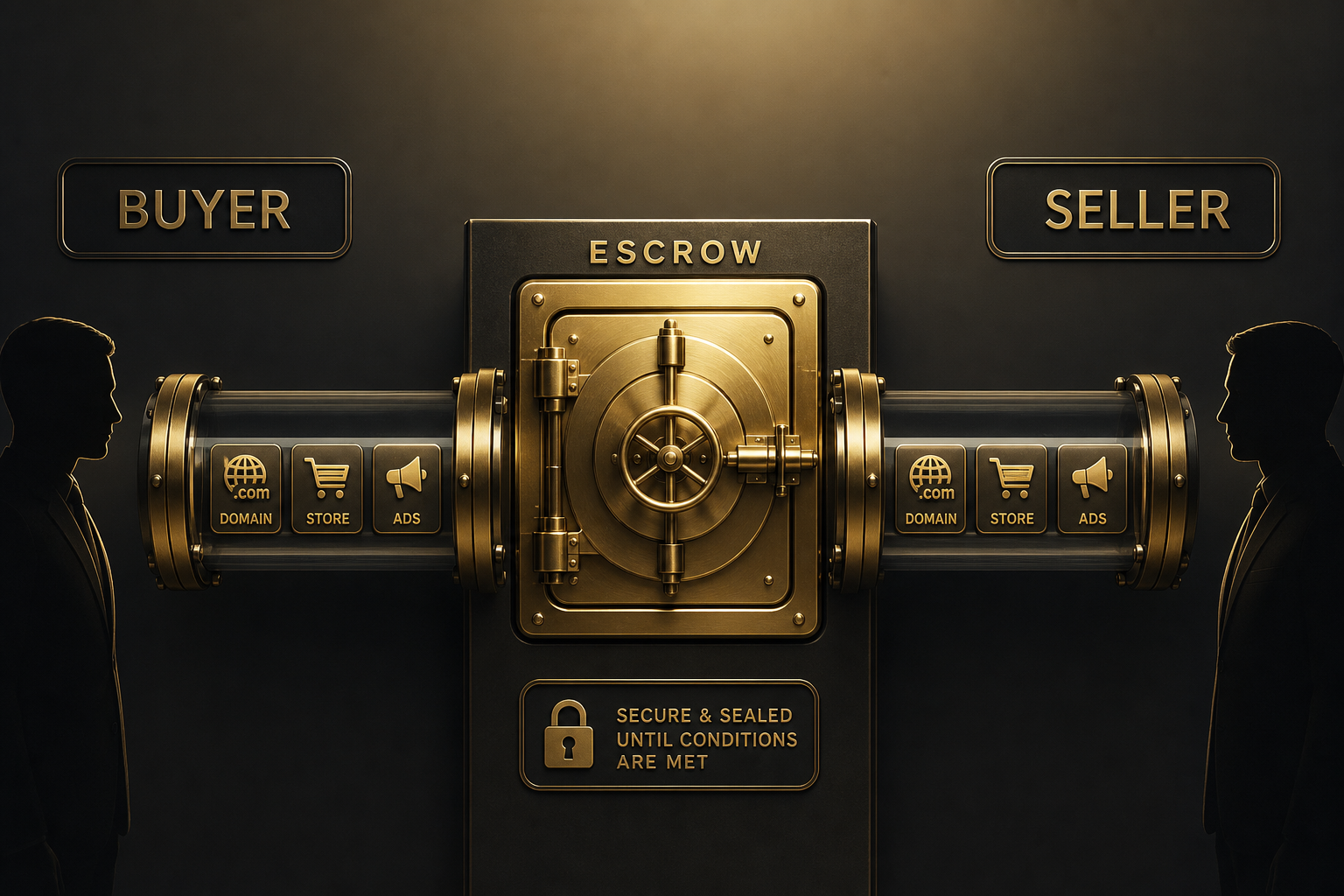
Escrow holds purchase funds with a neutral third party until defined conditions are met. For SaaS, that often means a clean lump-sum release at asset transfer. For ecommerce, lump-sum at close is frequently wrong — because value transfers in pieces (Shopify, Stripe, Meta, suppliers, domain, email) and failure modes appear days after the handshake.
This guide explains how escrow works when buying an online business, why milestone releases fit ecommerce better than single-shot payouts, and how profit verification before escrow shrinks the disputes that make escrow painful.
On this page
- What escrow is — and what it is not
- Typical ecommerce escrow timeline
- Why lump-sum release fails ecommerce
- Milestone escrow structure for ecommerce
- Escrow vs earnout — do not confuse them
- Who pays escrow fees
- Asset purchase agreement essentials for escrow
- Disputes: how they actually happen
- Escrow for sellers: getting paid without getting sued
- Marketplace escrow vs direct deal escrow
- When NOT to use standard escrow
- Checklist before funding escrow
- TrustExits and escrow-aligned closes
- Worked example: $280k Shopify brand close
- International and tax considerations
What escrow is — and what it is not
Escrow is a conditional payment rail. Buyer deposits agreed funds. Escrow agent releases funds to seller when:
- Asset transfer checklist is completed.
- Representations in the APA (Asset Purchase Agreement) are satisfied or waived.
- Holdback period expires without valid claim.
Escrow is not due diligence. It is not profit verification. It does not replace read-only audits of revenue, ads, and COGS before LOI — see how to verify revenue and profit. Escrow protects the transaction after price and diligence are settled.
Common providers in online business deals: Escrow.com, lawyers' IOLTA accounts, specialized M&A escrow for larger deals. Marketplaces sometimes offer integrated escrow — read fee structure and dispute rules before defaulting.
Typical ecommerce escrow timeline
- LOI signed — exclusivity, price range, diligence period.
- Diligence complete — profit verified, channel risk accepted.
- APA signed — definitions, reps, warranties, transfer list, escrow terms.
- Buyer funds escrow — full amount or first milestone per schedule.
- Asset transfer window — usually 3–14 days — seller grants admin access per checklist.
- Verification period — buyer confirms accounts work, no immediate policy flags.
- Release — lump-sum or milestones per agreement.
- Holdback (optional) — 5%–15% for 30–90 days for chargeback/supplier claims.
Total elapsed from funded escrow to final release: often 2–6 weeks for sub-$1M ecommerce — longer if transfer is messy or Meta/Google review delays access.
Why lump-sum release fails ecommerce
SaaS deals often transfer one codebase, one Stripe, one domain. Release at repo + billing handoff is reasonable.
Ecommerce transfers are multi-step and fragile:
- Shopify ownership transfers — but payment processor may require re-underwriting.
- Meta ad account may need Business Manager restructure; policy review can lag 48–72 hours.
- Google Ads + Merchant Center — feed ownership and verification ping differently post-transfer.
- Supplier relationships — intro calls, payment term resets, SKU discontinuation risk.
- Email (Klaviyo) — deliverability warmup if DNS changes wrong.
- Chargebacks — arrive on orders placed pre-close, fulfilled post-close.
Release 100% at first admin invite is how sellers get paid and buyers discover the ad account was personal-profile-linked and non-transferable. Milestone escrow aligns payment with verified transfer steps.
Milestone escrow structure for ecommerce
A practical split for a $400k cash deal (adjust percentages to risk):
Milestone 1 — 40% at core platform transfer (Day 0–3)
Released when:
- Shopify store owner role transferred to buyer entity.
- Domain DNS pointed or registrar push initiated.
- Primary email inbox (support@) access confirmed.
Buyer can operate storefront. Seller still has economic incentive to complete ads and payments.
Milestone 2 — 35% at revenue rail transfer (Day 3–10)
Released when:
- Stripe/PayPal/Shopify Payments under buyer control or approved successor account live.
- No processor hold blocking payouts beyond disclosed reserves.
- Klaviyo (or ESP) account ownership transferred.
Revenue collection without this milestone is operational risk — chargebacks land on wrong entity.
Milestone 3 — 15% at paid media transfer (Day 7–14)
Released when:
- Meta BM admin to buyer; ad account spending without policy block.
- Google Ads billing profile updated; GMC primary contact buyer-controlled.
- Pixel and CAPI events firing post-transfer spot check.
For Meta-heavy stores, tie this milestone to documented pre-close account health — channel verification matters as much as profit verification.
Holdback — 10% for 60–90 days
Covers:
- Undisclosed chargebacks and processor reserves.
- Supplier claims on pre-close POs.
- IP/trademark surprises surfaced post-close.
- Reps breach on revenue or ad spend misstatement.
Holdback is not optional on thin-margin stores. It is the escrow equivalent of a warranty.
Escrow vs earnout — do not confuse them
Escrow holds money for transfer and rep risk on a priced deal. Earnout pays additional consideration if post-close performance hits targets — different risk, different accounting.
Bad pattern: seller calls earnout "escrow" to inflate headline multiple. Buyer thinks $450k deal; $120k is contingent on 12-month revenue the seller still influences via supplier intro quality.
Keep escrow tied to transfer and disclosed liabilities. Keep earnout in separate section with clear metrics — profit, not revenue — and anti-manipulation clauses.
Who pays escrow fees
Negotiated 50/50 or buyer-pays in competitive markets. Escrow.com-style fees often 0.5%–1.5% of deal value with minimums — material on $150k deals, rounding error on $3M.
Factor fees into LOI economics. Fighting over $800 in escrow cost while leaving holdback undefined is amateur hour.
Asset purchase agreement essentials for escrow
Your APA should define:
- Exhibit A — Transfer checklist with objective completion criteria per asset.
- Escrow agent and instructions — who initiates release, dispute window.
- Representations on TTM revenue, SDE, ad spend, policy status — tied to holdback claims.
- Non-compete and seller support hours — 20–40 hours post-close standard on sub-$1M.
- Inventory and PO treatment if applicable.
- Employee/contractor transition — VA and agency handoff dates.
Vague APAs create escrow disputes. "Transfer social media" without account IDs is a lawsuit seed.
Disputes: how they actually happen
Top ecommerce escrow disputes we see:
- Ad account not transferable — seller knew; buyer discovers at Milestone 3.
- SDE misstatement >20% — holdback claim; seller argues diligence window closed.
- GMC suspension within 14 days post-close — buyer claims breach; seller claims buyer changed feed.
- Supplier cuts buyer — undisclosed relationship conflict.
- Chargeback spike on pre-close orders — holdback allocation fight.
Profit verification before LOI prevents categories 2 and reduces 1. Milestone structure prevents seller walking away fully paid before 3 is testable.
Escrow for sellers: getting paid without getting sued
Sellers fear buyer foot-dragging after transfer. Milestones protect sellers too — each release is earned by completed steps both sides can timestamp.
Seller best practices:
- Pre-build transfer runbook — BM admin invites staged, Shopify collaborator cleanup documented.
- Disclose processor reserves in writing before escrow funds.
- Do not change ad creatives or supplier terms during verification window.
- Accept holdback on deals under $500k — resistance signals hidden risk to buyers.
Clean dossiers with profit verified close faster — less buyer anxiety means shorter verification periods and fewer holdback claims.
Marketplace escrow vs direct deal escrow
Marketplaces (Flippa, Acquire-style, brokers) may mandate platform escrow or approved agents. Fees higher; process templated.
Direct deals use Escrow.com or counsel-managed accounts — more flexible milestone language, more APA responsibility on parties.
TrustExits sits between: verified dossiers, qualified intros, and structured close process — escrow terms aligned to ecommerce transfer reality, not SaaS lump-sum defaults copied blindly.
When NOT to use standard escrow
- Stock sale vs asset sale — entity purchase may use different closing mechanics.
- Deals with SBA or bank financing — lender controls fund flow; escrow adapts.
- Cross-border — FX timing, VAT, and entity jurisdiction add layers — use counsel.
- Inventory-heavy wholesale — separate inventory escrow or floor audit at close.
Ecommerce asset sales under $2M with operator buyers — milestone escrow + holdback is the sane default.
Checklist before funding escrow
Buyer and seller both:
- Profit verification complete — revenue AND profit, not badge alone.
- Channel transfer dry-run documented — especially Meta and GMC.
- APA signed with milestone exhibit and holdback terms.
- Escrow agent account created; fee payer agreed.
- Transfer calendar with named responsible party per asset.
- Seller support hours and response SLA in writing.
- Processor reserve disclosure attached.
Skip any item and you are funding hope, not a process.
TrustExits and escrow-aligned closes
We built TrustExits because ecommerce exits fail at transfer — after price agreement — more often than at valuation. Profit verification narrows price fights; milestone escrow narrows post-close fights.
Our how it works flow pairs verified dossiers with close checklists buyers and sellers can actually execute — Shopify, ads, email, suppliers — not generic "transfer assets" boilerplate.
Escrow is not magic. It is discipline with a neutral bank account. Structure it for ecommerce reality.
See how TrustExits structures verified exits from listing to release.
Worked example: $280k Shopify brand close
Deal structure from a recent composite (names changed):
- Verified SDE: $118k TTM — profit verified pre-listing.
- Price: $280k cash — 2.37x SDE, inside band for diversified DTC.
- Day 0: APA signed, Escrow.com funded $280k.
- Day 2: Milestone 1 released $112k — Shopify owner, domain, support inbox.
- Day 8: Milestone 2 released $98k — Stripe transferred, Klaviyo admin.
- Day 12: Milestone 3 released $42k — Meta BM + Google Ads billing live.
- Day 75: Holdback $28k released — no chargeback claims, supplier intro completed.
Total elapsed: 75 days to final dollar — 11 days active transfer work. Without pre-close profit verification, Milestone 3 would have stalled on undisclosed BM structure. Verification before escrow prevented a 3-week dispute.
International and tax considerations
Cross-border ecommerce deals add escrow complexity:
- FX timing: fund in buyer currency; define who eats swing if close spans rate move.
- VAT/GST: asset vs stock sale affects liability transfer — counsel required.
- Withholding: some jurisdictions tax seller proceeds at source — escrow instructions must net correctly.
Milestone structure still applies; only the APA and tax exhibits get heavier. Do not skip holdback because "it's a small international deal."
FAQ
How much should I hold in escrow for an ecommerce acquisition?
Buyers typically deposit 100% of cash consideration at close start. Structure release in milestones (40/35/15/10 holdback is common) rather than partial funding — sellers want certainty; buyers want gated release.
Is Escrow.com safe for buying a Shopify store?
Widely used for online business deals when APA terms are clear. Safety depends on milestone definitions and holdback — not the brand name alone.
Lump-sum vs milestone escrow — which is better?
Milestone for ecommerce with paid media and multi-platform transfer. Lump-sum defensible only for simple assets (domain + content, no ad dependency).
How long should the holdback period be?
60–90 days for chargebacks and processor issues; 90–180 days if supplier PO exposure or IP reps are heavy. Shorter holdbacks favor sellers; longer protect buyers on thin-margin stores.
Does TrustExits handle escrow directly?
We guide milestone structure and transfer checklists aligned to verified listings. Escrow agent selection remains with parties — often Escrow.com or counsel. Process details here.
Do not wire on trust. Structure escrow for ecommerce transfer — milestones, holdback, verified profit before you fund.
Related reading & next steps
Keep going with the cluster — or jump straight into a TrustExits tool.
- How Much Is My Ecommerce Business Worth? (2026 Guide)
- Revenue vs Profit: Why "Revenue Verified" Is Not Enough
- Flippa Alternatives in 2026 (Honest Comparison)
- How to Sell Your Shopify Store (Complete 2026 Guide)
TrustExits pages worth opening
Ready for numbers, not screenshots?
Run a free estimate or see how we verify profit before a listing goes live.