
Empire Flippers vs Flippa vs Acquire.com vs TrustExits: Fees Compared
Etienne Hurpin, Founder of TrustExits · · 14 min read
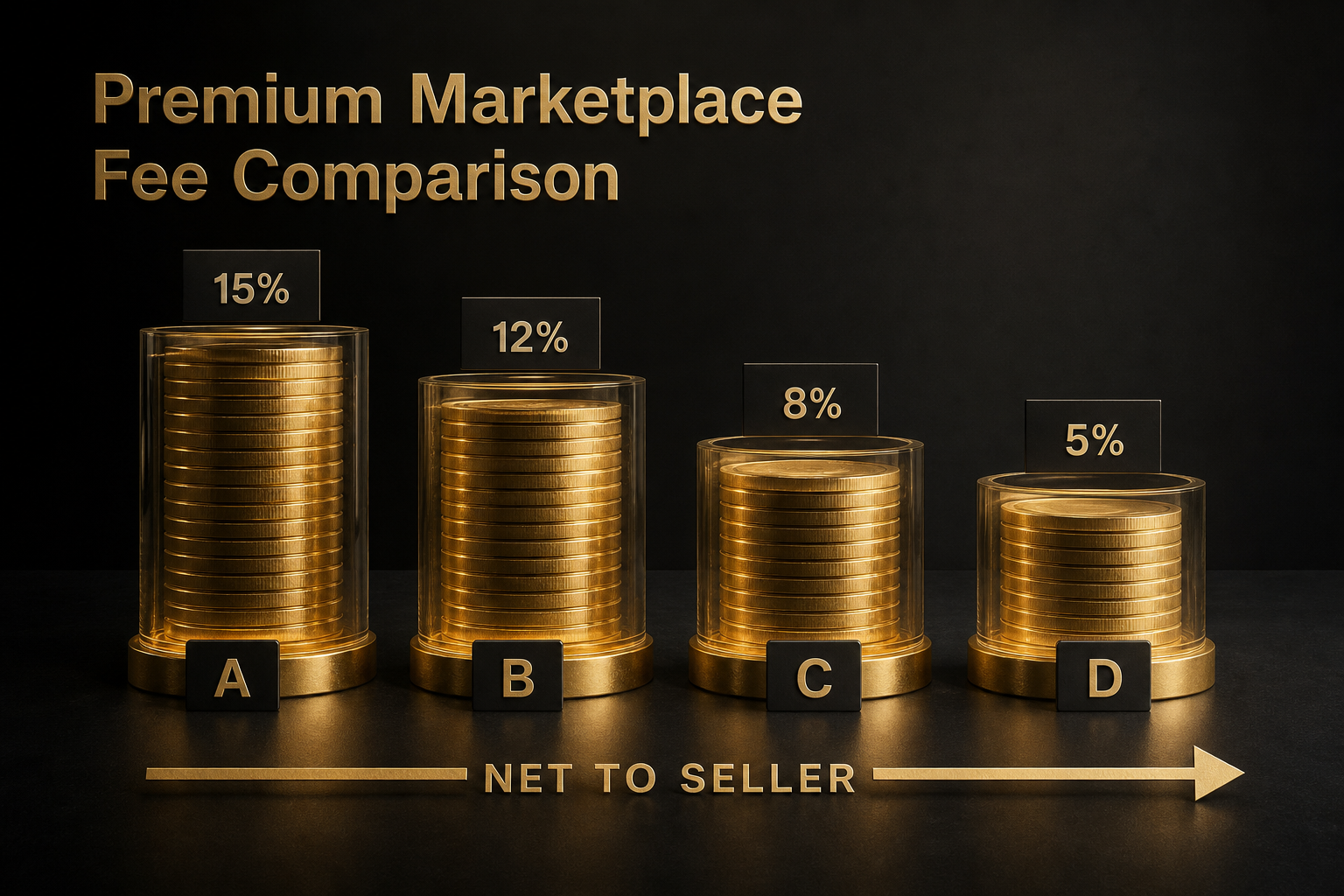
Headline success fees lie. A platform advertising "8% seller fee" can net you less than one at "15%" once listing packages, minimum commissions, escrow splits, and three months of buyer tire-kickers are included. For ecommerce sellers - where deals already die on margin truth - fee math must be all-in, not brochure math.
I built TrustExits around profit-verified store exits, so I have opinions. This comparison is still honest: Empire Flippers, Flippa, and Acquire.com each win specific deal profiles. Below is how public 2026 fee tiers actually land at two common clearing prices - $50,000 and $200,000 - plus verification depth, ecommerce fit, and what you are paying for beyond the percentage. Verify live pricing before you sign; platforms change tiers.
On this page
- How to compare marketplace fees fairly
- Public 2026 fee snapshot (verify live)
- Comparison table: $50,000 exit
- Comparison table: $200,000 exit
- What you are actually paying for
- Verification depth by platform
- Ecommerce fit: who each platform is for
- Empire Flippers: where it wins
- Flippa: where it wins
- Acquire.com: where it wins
- TrustExits: where it wins
- Hidden fees and time costs not in the table
- Decision framework by exit size
How to compare marketplace fees fairly
Before the tables, align assumptions:
- Purchase price = amount wired to seller before personal tax (asset sale, not stock).
- Seller-side fees only in the main comparison. Buyers often pay subscriptions or escrow shares on some platforms - note where that matters for deal velocity.
- Escrow modeled from public Escrow.com tiers for Flippa (typically 1.2%+ paid by parties). Empire Flippers and Acquire.com often bundle escrow differently. TrustExits absorbs Escrow.com inside the seller commission per /fees.
- Listing and prep costs included when mandatory or commonly paid (Flippa listing packages, Acquire listing subscriptions).
- Time cost not dollarized here but real - self-serve vs curated vetting changes days-to-close.
Every number below reflects public 2026 tiers as commonly published. Fee schedules change. Verify live pages before you sign a listing agreement.
Public 2026 fee snapshot (verify live)
Quick reference from each platform's public pricing pages and seller flows as of 2026. Treat this as orientation, not a quote.
| Platform | Typical seller success fee | Listing / vetting | Escrow | Buyer-side fees | Verification included? |
|---|---|---|---|---|---|
| Empire Flippers | ~15% under $700k (public tier; verify live), $10k minimum commission often cited | Free to list; exclusivity required; vetting queue | Often included in broker commission | $0 platform fee commonly cited | Human vetting: revenue, traffic, partial profit review for vetted listings |
| Flippa | ~10% success fee on many ecommerce bands (verify tier) | $49+ listing for $10k-$50k band; optional NDA packages (~$199) on some tiers | Escrow.com paid by parties (from ~1.2%) | $0; optional Premium subscription for buyers | Revenue verification optional; profit not native |
| Acquire.com | ~6%-8% sliding by deal size (verify live) | Listing subscription ~$25-$100/mo on public tiers | Often included in success fee | Buyer subscription ~$390-$780/yr on public tiers | MRR/revenue focus; ecommerce not core |
| TrustExits | 8% seller all-in (5% founding for first 50 listings), min $800 standard / $500 founding | Free Standard listing; optional Featured $99 | Included - platform pays Escrow.com | $0, always | Profit verified + channel dependency audit from source connections |
Acquire.com's lower headline rate is real for qualifying SaaS - and misleading if you expect the same treatment for a Meta-heavy Shopify store. Many ecommerce sellers never pass listing criteria. Compare fit, not sticker rate.
Comparison table: $50,000 exit
Scenario: profitable Shopify brand, ~$4k/month SDE, closes at $50,000. Seller-side costs only. Competitor rows use public 2026 tiers - verify live. TrustExits numbers from published /fees (8% all-in, escrow included; founding 5% shown separately).
| Platform | Success / commission | Listing / other | Escrow (seller share) | Total seller cost | Net to seller | Effective take |
|---|---|---|---|---|---|---|
| Empire Flippers | $10,000 (15% = $7,500, public $10k min often applies - verify live) | $0 listing | $0 (typically bundled) | $10,000 | $40,000 | ~20% |
| Flippa (typical self-serve) | $5,000 (10% public tier) | ~$49 listing | ~$600 (Escrow.com ~1.2% if seller pays full) | ~$5,649 | ~$44,351 | ~11.3% |
| Flippa (+ NDA package) | $5,000 | ~$248 ($49 + ~$199 NDA tier) | ~$600 | ~$5,848 | ~$44,152 | ~11.7% |
| Acquire.com | Often N/A - typical Shopify store at $50k unlikely to list | - | - | - | - | - |
| TrustExits (standard 8%) | $4,000 (8% all-in) | $0 Standard listing | $0 (included in commission) | $4,000 | $46,000 | 8% |
| TrustExits (founding 5%) | $2,500 (5% all-in, first 50 listings) | $0 | $0 (included) | $2,500 | $47,500 | 5% |
At $50k, Flippa looks cheapest on headline math - if you close without broker help and survive buyer quality variance. Empire's public minimum commission hurts small deals but buys vetting and buyer pool filtering. TrustExits standard 8% all-in nets ~$1,650 more than Flippa self-serve in this table - and ~$6,000 more than Empire - with escrow already inside the line item.
The hidden cost at $50k is failure rate. Two months on Flippa self-serve with no close still costs listing fees and opportunity. Factor probability of close, not just success fee.
Comparison table: $200,000 exit
Scenario: DTC brand, ~$55k SDE, ~3.6x multiple, closes at $200,000. Same assumptions. Verify live tiers before you model your deal.
| Platform | Success / commission | Listing / other | Escrow (seller share) | Total seller cost | Net to seller | Effective take |
|---|---|---|---|---|---|---|
| Empire Flippers | $30,000 (15% public tier under $700k) | $0 | $0 (typically bundled) | $30,000 | $170,000 | 15% |
| Flippa (typical self-serve) | $20,000 (10%) | ~$499 (higher listing band - verify tier) | ~$2,400 (~1.2% if seller pays full escrow) | ~$22,899 | ~$177,101 | ~11.4% |
| Acquire.com (if qualified SaaS-like) | ~$12,000 (6% public mid band - verify live) | ~$0-$1,200/yr listing sub (prorated) | $0 (often bundled) | ~$12,000-$13,200 | ~$186,800-$188,000 | ~6%-6.6% |
| TrustExits (standard 8%) | $16,000 (8% all-in) | $0 Standard | $0 (included) | $16,000 | $184,000 | 8% |
| TrustExits (founding 5%) | $10,000 (5% all-in) | $0 | $0 (included) | $10,000 | $190,000 | 5% |
At $200k, spread widens. Acquire looks unbeatable - for assets it accepts. Ecommerce stores with ad-heavy economics and inventory often never enter that funnel. Empire charges the full public 15% band. Flippa self-serve can still beat Empire on paper if escrow is split and the deal closes clean.
TrustExits at 8% all-in: net $184,000 vs Empire $170,000 - roughly $14,000 more to seller before tax in this scenario, with profit verification and escrow inside one line item. Founding 5% nets $190,000. See full tier detail on /fees.
What you are actually paying for
Success fees buy four things. Rank what your exit needs:
- Liquidity. Flippa wins raw eyeballs. Good for micro-deals and price discovery.
- Vetting and buyer qualification. Empire and TrustExits spend human hours before go-live. That reduces tire-kickers; it is not free.
- Verification depth. Revenue badges vs profit reconciliation vs channel dependency. Ecommerce needs the latter two. Paying 15% for revenue theater is worse than 8% for profit truth.
- Close support. Migration, escrow choreography, ad account transfer checklists. Broker-assisted tiers charge for hours not always shown in %.
A cheap fee on a deal that retrades twice is expensive. A higher fee on a 45-day verified close can net more and faster. Start with how much your store is worth so fee math sits on a real clearing price.
Verification depth by platform
What each venue typically opens before a listing goes live for ecommerce:
| Platform | Revenue | Ad accounts | COGS reconcile | Channel flags |
|---|---|---|---|---|
| Flippa self-serve | Often (Stripe/Shopify) | Rare at list | Rare | No |
| Empire Flippers | Yes | Often in vetting | Partial | Varies |
| Acquire.com | Yes | SaaS-focused | N/A for most stores | Limited |
| TrustExits | Yes (source read) | Yes | Yes | Yes |
Depth affects time-to-close more than headline fee. A buyer who trusts the dossier on day one skips the retrade that kills open-marketplace deals at LOI stage.
Ecommerce fit: who each platform is for
Fee comparison without fit comparison wastes weeks:
- Flippa: Broad digital asset floor. Best for sub-$75k simple assets, content sites, and sellers who need speed over proof.
- Empire Flippers: Curated broker for vetted content, FBA, SaaS, and select ecommerce from roughly $50k-$2M+. Strong buyer list; exclusivity and queue.
- Acquire.com: Startup and SaaS acquirers. Ecommerce is edge case unless metrics look like software.
- TrustExits: Shopify and DTC stores where profit after ads and COGS is the underwriting story. Not a generalist digital asset bazaar.
Wrong room beats wrong fee. A 6% Acquire quote you never qualify for nets zero.
Empire Flippers: where it wins
Empire built reputation on vetted content and FBA, expanded to SaaS and select ecommerce. Strengths:
- Human vetting before listing goes live.
- Established buyer list for six-figure digital assets.
- Escrow often bundled - one less line item to negotiate.
- White-glove prep for sellers who want hands-off listing build.
Where it hurts for Shopify-heavy sellers:
- Public ~15% band and minimum commission compress net on sub-$100k deals (see $50k table).
- Ecommerce profit verification depth varies vs dedicated store practitioners.
- Exclusivity and vetting queue add calendar time.
Choose Empire when your asset matches their vetted categories, you want broker-led prep, and you accept the public commission stack. Verify current tiers on their site before listing.
Flippa: where it wins
Flippa is the broadest floor. Self-serve at $50k-$150k can work for simple assets with patient sellers.
Strengths:
- Fastest path to market - publish in hours.
- Largest buyer pool by volume.
- ~10% public success fee can beat broker commissions on paper.
- Works for apps, domains, newsletters, FBA, and starter sites Flippa was built for.
Weaknesses at scale for ecommerce:
- Revenue verification without native profit + channel stack - buyers re-diligence anyway.
- Escrow and listing packages stack on top of success fee.
- Buyer quality variance creates seller time tax.
Flippa wins when you need speed, tolerate noise, and have clean self-serve export skills. It fails fee math when deals die after 60 days of unqualified inquiries. See Flippa alternatives in 2026 for venue-by-venue fit.
Acquire.com: where it wins
Acquire's public 6%-8% seller fee is disruptive for qualifying startups with ARR metrics buyers trust. The platform optimizes for software, not contribution margin after Meta spend.
Strengths:
- Lower headline success fee on deals that fit.
- Strong SaaS buyer pool and MRR-native verification.
- Escrow often bundled in success fee on public tiers.
Ecommerce reality:
- Listings skew SaaS; Shopify stores are edge cases.
- Buyer subscriptions can slow offer flow vs zero-buyer-fee venues.
- Verification stack = revenue/MRR, not COGS + ads reconciliation.
Choose Acquire when you actually are SaaS. Do not choose it for fee sticker on a Shopify brand.
TrustExits: where it wins
We charge for what closes store deals: profit-verified SDE, channel dependency surfaced, buyers who expect that standard - in one seller-side number.
- 8% seller all-in - Escrow.com fee included, we pay it. Buyers pay $0.
- 5% founding for the first 50 listings (min $500), locked for the life of the listing.
- Free Standard listing - no $49+$199 package stack before you know if the deal closes.
- Verification from source connections, not screenshot theater.
We are not cheapest on every hypothetical row - Flippa self-serve can beat us on paper at $50k if nothing goes wrong. We are optimized for seller net on profitable DTC when retrades, escrow line items, and buyer subscription friction count. Full grid on /fees and /compare.
Hidden fees and time costs not in the table
Effective take exceeds success fee plus escrow. Model these before you choose:
- Listing renewals. Flippa self-serve listings expire; renewals add up over 90-day sells that stall.
- Broker-assisted upsells. Flippa and Empire broker tiers may charge flat or hourly on top of success fee - read the order form.
- Legal and APA. $1,500-$5,000 for ecommerce asset purchase agreement review, unrelated to marketplace but mandatory.
- Accountant reconciliation. If books were never matched to Stripe, fixing pre-list costs $500-$3,000 - same on any platform.
- Retrade discount. One 15% price drop on a $200k deal costs $30,000 - more than any fee delta in the tables above.
- Seller time. Self-serve Flippa at 10% plus 60 hours of buyer filtering can net less than curated 8% with 15 hours of work.
- Buyer-side subscriptions. Acquire buyer fees do not hit seller P&L directly but can reduce offer count and lengthen time-on-market.
All-in seller net = purchase price minus every fee minus time minus retrade risk. Spreadsheets that stop at success fee % lie gently. Run your ask through both worked tables before you sign.
Decision framework by exit size
Under $75k
Flippa self-serve or TrustExits if profit verification helps you stand out in a noisy band. Empire's public minimum commission rarely wins on net unless bundled service saves you a month of failed self-serve.
$75k-$250k
TrustExits vs Empire vs Flippa - compare effective take on your exact price using both tables. If SDE is messy, verification ROI rises. Cross-check valuation with how much your ecommerce business is worth.
Above $250k
Empire, specialized brokers, or TrustExits for DTC-native verification. Acquire only if metrics look like software. Always verify live commission tiers before exclusivity.
FAQ
Who has the lowest fees for ecommerce?
Headline: often Flippa self-serve on paper. All-in for stores that close clean: compare effective take after listing, escrow, and retrades. TrustExits 8% all-in with escrow included often beats Empire on net; Flippa can beat both if the deal closes fast with no retrade.
Does the buyer pay fees too?
Often yes on some platforms - Acquire buyer subscriptions, Flippa Premium, escrow splits. TrustExits buyers pay $0. Seller tables above isolate seller-side; negotiate total fee stack in LOI.
Are escrow fees included in TrustExits 8%?
Yes. The seller pays one success fee at closing; we pay Escrow.com from that commission. See /fees.
Should I avoid Empire's commission on small deals?
Not automatically. If vetting gets you to close 30 days faster at $50k vs Flippa ghost listings, effective economics can beat lower % on paper. Run the $50k table with live quotes.
Can I trust these fee numbers?
Use them for orientation. Every competitor row says "public 2026 tiers - verify live." TrustExits tiers are published on /fees and match /compare.
Where does Acquire.com fit ecommerce?
Edge case. If your store looks like SaaS (recurring revenue, clean MRR narrative), you might qualify. Typical DTC with SKU COGS and Meta spend usually belongs elsewhere.
Model your exit at your price, not a blog example. Compare all-in fees on TrustExits - then add what a retrade costs in weeks.
Related reading & next steps
Keep going with the cluster - or jump straight into a TrustExits tool.
- How Much Is My Ecommerce Business Worth? (2026 Guide)
- Revenue vs Profit: Why "Revenue Verified" Is Not Enough
- Flippa Alternatives in 2026 (Honest Comparison)
- How to Sell Your Shopify Store (Complete 2026 Guide)
TrustExits pages worth opening
Ready for numbers, not screenshots?
Run a free estimate or see how we verify profit before a listing goes live.